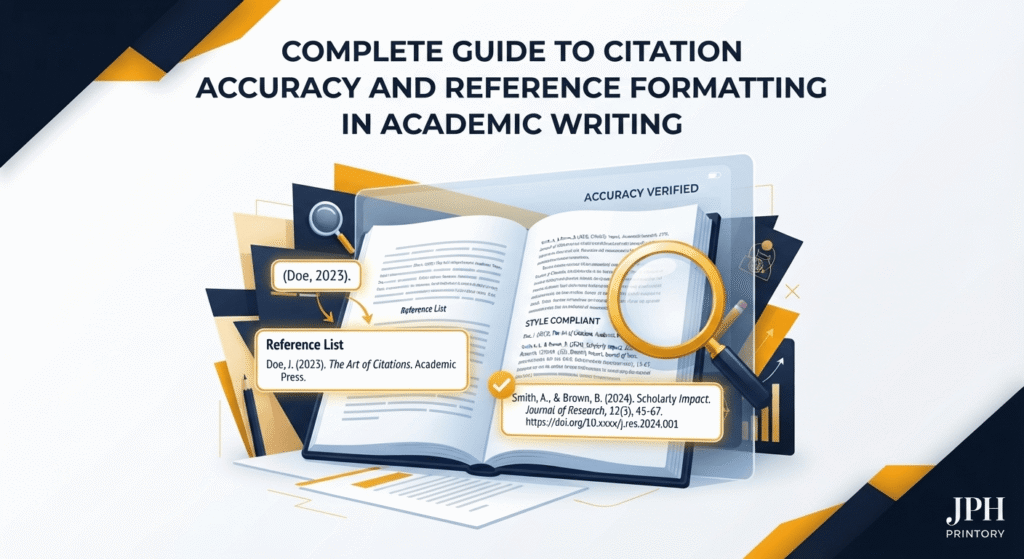
Complete Guide to Citation Accuracy and Reference Formatting
Every credible research paper or book stands on the shoulders of prior scholarship. How you cite those works—and how carefully you verify every entry in your reference list—tells editors, peer reviewers, and readers a great deal about the rigor of your research. Even strong findings can face friction during peer review if citations are inconsistently formatted, missing key details, or mismatched between the text and the bibliography. Developing strong citation habits saves time before submission and strengthens the authority of your work.
Why Citation Accuracy Is Critical in Scholarly Publishing
Citations serve three practical purposes: they give credit to original authors for ideas, data, and frameworks; they allow readers to locate and verify the exact sources you consulted; and they situate your study within an ongoing scholarly conversation.
When citation formatting is careless, problems quickly multiply. A missing publication year, an incorrect volume or page number, or an author’s name spelled differently in the text than in the reference list can make it difficult for reviewers or indexing systems to trace a source. In automated or semi-automated editorial checks, broken references or missing identifiers can also slow down copyediting and production.
Editors and reviewers often treat reference accuracy as an indicator of overall manuscript care. If citation details are sloppy or incomplete, reviewers may wonder whether data points, quotations, or literature interpretations were checked with equal care. Clean, verifiable citations remove unnecessary doubt and help reviewers focus on your argument and methodology.
Navigating Major Citation Styles Without Confusion
Different disciplines and journals rely on distinct citation conventions. Common styles include APA, MLA, Chicago, Harvard, IEEE, Vancouver, and OSCOLA. Each style has its own rules for:
-
In-text placement: Author-date parentheses, superscript numbers, bracketed numbers, or footnotes/endnotes.
-
Punctuation and capitalization: Title case versus sentence case, italicization of journal or book titles, and comma or period placement.
-
Multiple authors: When to list all authors versus using et al. or listing up to a specific count.
-
Source types: Distinct templates for journal articles, edited book chapters, monographs, conference proceedings, reports, theses, and online sources.
The most common mistake authors make is mixing rules from different styles—especially when adapting a draft or thesis chapter for a new target journal. Choosing the required style guide from the start and applying it uniformly across the entire document prevents tedious rework later.
Paying attention to subtle distinctions within a style guide is equally important. For example, a single journal article entry may require sentence case for the article title, title case and italics for the journal name, specific punctuation before the volume and issue numbers, and a consistent page range or article identifier. Following the exact rules of the target style guide keeps the bibliography uniform from first entry to last.
In-Text Citations vs. Reference List: Avoiding Mismatches
A thorough citation check always compares what appears inside the body text (including tables, figures, and notes) against the final reference list. Two classic issues appear frequently in unedited manuscripts:
-
Orphan in-text citations: A source is cited in a paragraph or table, but its full bibliographic entry is missing from the reference list.
-
Uncited reference entries: A source appears in the bibliography, but there is no corresponding citation in the text—often left over from earlier drafts or literature notes.
Checking every entry one by one ensures complete alignment. Paying attention to letters appended to years (such as 2024a and 2024b) when an author has multiple works in the same year is another small detail that keeps citations accurate and prevents confusion between different studies.
Verifying Metadata, DOIs, and Source Reliability
Modern referencing goes beyond matching brackets to list items. Editors and researchers increasingly expect complete bibliographic metadata and persistent links such as DOIs or stable URLs when available. Verifying a reference against the actual published record helps catch subtle errors introduced by auto-generated citations from reference managers or search results.
Reference management tools are helpful for organizing sources, but they are not a substitute for human review. Imported records often contain incomplete author names, all-caps titles, wrong issue numbers, or missing page ranges. Reviewing your formatted bibliography line by line before submission catches issues that software alone can miss.
It is also wise to verify that every cited source actually supports the claim made in the text. Checking publication details alongside source context ensures your references are accurate, relevant, and properly attributed.
A Practical Pre-Submission Citation Checklist
Before submitting a manuscript or thesis, walking through a short verification pass can make a noticeable difference:
-
Confirm that the citation style matches the target journal or institutional guidelines.
-
Check that every in-text citation has a matching entry in the reference list and vice versa.
-
Verify author spellings, publication years, journal names, volume/issue numbers, and page ranges.
-
Standardize DOI formatting and check that links resolve properly where required.
-
Ensure consistent capitalization, italics, and punctuation across all reference types.
Accurate citations give your argument a solid foundation and make your manuscript cleaner for editors and reviewers to evaluate. At JPH Printory, we support researchers, authors, and publishers with reference formatting, bibliographic verification, and citation cleanup so manuscripts are ready for publication.